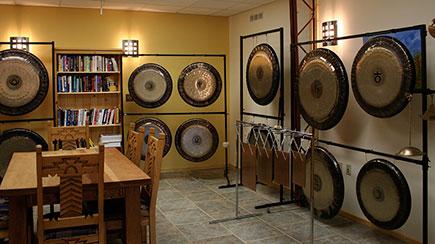
June 2026 brought us to the United States for what turned out to be one of the most formative journeys in our sound healing practice — training with Don Conreaux, and the quiet discovery that would change what we're able to offer at Singing Bowls Australia.
We didn't plan for the trip to be about bowls. It started as a pilgrimage for gong knowledge.
Don Conreaux
Don Conreaux is one of the most significant living figures in Western gong work. A student of Yogi Bhajan and the originator of what he calls Holistic Resonance, Don has spent more than five decades studying the therapeutic and ceremonial dimensions of gong sound.
He is the architect of a practice that integrates planetary frequencies, ceremonial intent, and deep acoustic understanding. His workshops draw practitioners from across the globe — sound healers, yoga teachers, therapists, and musicians seeking something beyond technique.
Our Gong Journey
We didn't arrive at Don's workshop as beginners. Our gong education had begun earlier under Benton Mehtab, whose approach to gong facilitation gave us our foundational understanding of sound fields, overtone structure, and the therapeutic arc of a gong bath. Benton's teaching planted the seed; Don's work grew it into something larger.
What struck us immediately about Don's approach was its comprehensiveness. Where much gong teaching focuses on technique — where to strike, how hard, what sequence — Don works in the register of intention, cosmology, and practitioner development. He speaks about the gong not as an instrument you play but as a vehicle you learn to become.
The Training
Several days of immersion. Morning sessions beginning before sunrise, working with specific planetary gong frequencies as they corresponded to the day's celestial conditions. Don's concept of planetary resonance — the idea that Paiste's planetary gongs (tuned to frequencies corresponding to each planet's orbital period, as calculated by Hans Cousto) should be used in relationship to actual planetary hours — shifted our understanding of session timing and intention.
Afternoons were physical: extended gong baths in which participants were both subject and, rotating, facilitator. There is nothing like being inside a well-executed gong bath to understand what you are trying to create for others.
Don's central teaching, simplified: The gong player is not separate from the sound. You don't play at the room — you become the room. Technique without this understanding produces noise. Technique with it produces medicine.
Evenings were for discussion: sound healing history, the neurological basis for gong work, how to structure sessions for different intentions. Don's breadth of reference — from Nada Yoga philosophy to contemporary research on the autonomic nervous system — made these conversations extraordinary.
The Discovery
The bowl connection came through the community around the training.
Sound healers at this level of practice are particular about their instruments. Conversations about suppliers, about quality, about what separates a merely functional bowl from one that truly sings — these are the conversations that happen when practitioners compare notes at this level. We had always been selective about what we stocked at Singing Bowls Australia, but there had been a ceiling on what was available to us — and we knew it.
In America, we were introduced to a supplier whose commitment to quartz purity and acoustic quality was unlike anything we had previously encountered. The difference isn't visible — you can't see purity. But you hear it immediately. And after years of handling bowls, your hands begin to know it too: the weight distribution, the ring when you tap the rim lightly with a finger, the way the sustain unfolds in the first seconds after striking.
Their standards begin with source material: specifically selected quartz crystal, tested before processing. The difference between 99% and 99.99% pure quartz isn't theoretical — it manifests acoustically in the clarity of the fundamental tone, the cleanness of the overtone series, and the length and quality of the sustain. A less pure bowl produces a muddier sound, with overtones that don't stack as cleanly. You hear it most clearly in a quiet room, held against silence.
What This Means for Our Stock
We came home from America with two things: a deepened understanding of gong facilitation, and a new supplier relationship that represents the highest standard of crystal singing bowl quality we have yet carried.
Sound healing at a professional level requires professional instruments. The bowls that a practitioner uses in a clinical or therapeutic setting — where a client may be in a vulnerable emotional or physical state — need to be instruments you trust completely. Not every bowl meets that standard. Many that look beautiful in photographs produce sounds that don't hold up in sustained professional practice.
We are acutely aware that people in Australia searching for high-quality crystal singing bowls — whether beginning practitioners or experienced facilitators looking to upgrade — deserve honest guidance about what's genuinely available. The Australian market has historically had less access to the highest-grade instruments than the United States or Europe. That's something we're committed to changing.
The bowls we now stock at this quality level are not common. They require careful selection, rigorous quality assessment, and a supplier willing to prioritise acoustic performance over production volume. We found that in America, and we've brought it home.
A Note on Quality in Sound Healing
We return to this question often in our sessions and in conversations with customers: what actually makes one singing bowl more effective than another for healing work?
The honest answer is that multiple factors interact. Purity of material matters, but so does size, shape, and the specific frequencies of the fundamental and its overtones. A bowl that is theoretically "perfect" in purity but whose overtone series creates dissonance isn't the right instrument for harmonically sensitive work. What we seek — and what we found in America — are bowls where every factor aligns: the purest available quartz, skilled craftsmanship in the shaping and finishing process, and acoustic quality that holds up under rigorous assessment.
These are the bowls that support the best sound healing work. The training with Don Conreaux gave us a clearer understanding of what that means in practice. The supplier discovery gave us a pathway to offer it.
If you're building a professional practice, or choosing your first instrument with an eye toward quality that will last a career, we welcome the conversation. What we learned in America informs what we're now able to help you find.