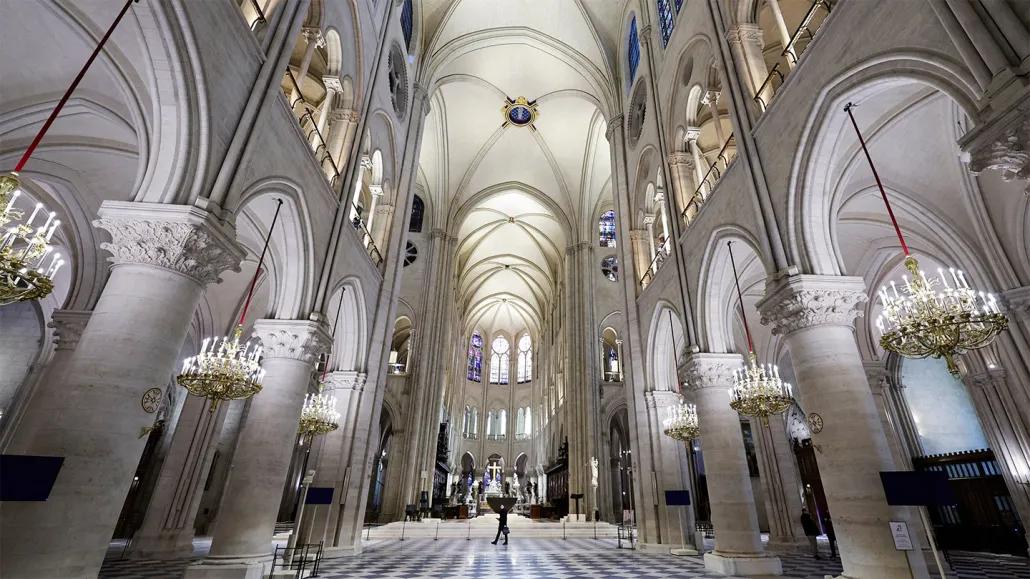
Walk into a Gothic cathedral and clap your hands. The sound doesn't simply stop—it blooms, multiplies, and fades over seconds. In some cathedrals, reverberation exceeds ten seconds. The stone walls, vaulted ceilings, and vast volumes create acoustic environments unlike anything in nature or modern architecture.
This was not accidental. The medieval builders who constructed these spaces understood—empirically if not theoretically—that they were creating instruments. Gregorian chant, the music composed for these spaces, exploited their acoustic properties so precisely that performing the same chants in a modern concert hall loses something essential. The architecture and the music were designed together.
The Physics of Cathedral Sound
Reverberation Time
Reverberation time (RT60) measures how long it takes for sound to decay by 60 decibels after the source stops. In a typical living room, RT60 is about 0.5 seconds. In a recording studio, it might be 0.3 seconds or less. In Gothic cathedrals:
| Cathedral | Reverberation Time (RT60) |
|---|---|
| Notre-Dame de Paris (pre-2019) | ~6 seconds |
| Cologne Cathedral | ~7 seconds |
| York Minster | ~8 seconds |
| Chartres Cathedral | ~8 seconds |
| St. Paul's Cathedral, London | ~9 seconds |
| Hagia Sophia, Istanbul | ~11 seconds |
At these reverberation times, sound persists long after the source stops. A choir sustaining a note hears previous notes still decaying around them. The space itself becomes part of the sound, adding depth, complexity, and what can only be described as "presence."
Why Cathedrals Reverberate
Several architectural features contribute to extreme reverberation:
- Hard surfaces everywhere: Stone walls, floors, and ceilings reflect rather than absorb sound. Unlike wood or fabric, stone returns almost all acoustic energy.
- Parallel walls: Sound bounces back and forth between parallel surfaces, creating flutter echoes and extended decay.
- Vaulted ceilings: The curved surfaces of Gothic vaults focus and distribute sound, preventing it from escaping upward.
- Vast volume: Large interior spaces mean sound waves travel longer distances before encountering surfaces, extending decay time.
- Minimal absorption: In the original medieval state, cathedrals had no pews, no carpeting, no padded seating—just stone and air.
The Reverberant Field
In highly reverberant spaces, direct sound (traveling straight from source to listener) quickly becomes overwhelmed by reflected sound bouncing off surfaces. Listeners experience what acousticians call a "reverberant field"—sound arriving from all directions with roughly equal intensity. This creates the sense that sound fills the entire space rather than emanating from a specific point.
In a reverberant field, the human ear struggles to locate the sound source. Music seems to come from everywhere and nowhere. For medieval worshippers, this dissolution of sonic origin reinforced the theological message: the sound was not coming from human singers but from the divine space itself.
Gregorian Chant: Music for Stone
Gregorian chant evolved over centuries in these acoustic environments. Its musical characteristics are inseparable from cathedral acoustics:
Monophony (Single Melodic Line)
Gregorian chant is monophonic—one melody sung in unison, without harmony or counterpoint. In a reverberant space, this is practical: multiple independent melodic lines would blur together, becoming mud. A single line remains clear even as it reverberates.
Slow Movement
The melodies move slowly, with sustained notes and stepwise motion. Fast passages would smear into incoherence in a six-second reverb. The tempo of chant matches the decay time of the space—new notes arrive as old notes fade, creating seamless continuity.
Modal Harmony
Chant uses the medieval modes (Dorian, Phrygian, Lydian, Mixolydian, etc.) rather than modern major/minor scales. Modal melodies have a floating, ambiguous quality that suits reverberant spaces. The lack of strong harmonic tension means notes blend rather than clash as they overlap in decay.
Unmeasured Rhythm
Traditional Gregorian chant is not metrically strict—it flows with the natural rhythm of the Latin text rather than a fixed beat. This flexibility allows singers to adjust phrasing to the acoustic response of their specific space.
Open Intervals
When chant does use intervals, it favors perfect fifths, octaves, and fourths—the most consonant intervals that blend smoothly in reverberant overlap. The "beating" of less consonant intervals (like thirds) would be exaggerated by sustained reverberation.
The acoustic logic: Every characteristic of Gregorian chant—monophony, slow tempo, modal melody, open intervals—is explained by reverberant acoustics. The music was not composed and then placed in cathedrals; it evolved inside them over centuries.
The Schola Cantorum: Singers as Scientists
Medieval monks in the schola cantorum (choir school) developed sophisticated understanding of their acoustic environment through daily practice over lifetimes. They knew:
- Where to stand for optimal resonance
- Which notes the building "supported" versus "swallowed"
- How long to sustain tones for smooth overlap
- When to pause for the reverberant tail to clear
This was empirical acoustics—knowledge gained through practice rather than theory. The monks became experts in their specific instrument: their cathedral.
When the same chants were performed in different cathedrals during monastic visits, singers would adjust tempo and phrasing to the new acoustic. This flexibility was built into the tradition—the notation indicated melody and text but left interpretation to the singers' acoustic judgment.
Specific Cathedral Acoustics
Notre-Dame de Paris
Before the 2019 fire, Notre-Dame had reverberation around 6 seconds—moderate by cathedral standards but still extraordinary by modern experience. The famous "Notre-Dame school" of polyphony (12th-13th centuries) developed here, pushing the boundaries of what multi-voice music was possible in the space. The innovations of composers like Léonin and Pérotin were architectural as much as musical.
Chartres Cathedral
Chartres, with its 8-second reverb, is particularly remarkable for its uniformity of sound distribution. Unlike some cathedrals with "hot spots" and "dead spots," Chartres creates an even reverberant field throughout the nave. Acoustic analysis suggests this may relate to the specific geometry of its vaults—though whether medieval builders understood this consciously is unknown.
Hagia Sophia
Built in the 6th century as a Byzantine church, Hagia Sophia has one of the longest reverberation times of any historic religious structure—exceeding 11 seconds in some measurements. Byzantine chant, like Gregorian chant, is monophonic and slowly moving, for the same acoustic reasons. The dome's geometry creates unusual focusing effects, including a "whispering gallery" phenomenon.
King's College Chapel, Cambridge
A late Gothic chapel (completed 1515) with a fan-vaulted ceiling that creates complex acoustic patterns. The famous "Nine Lessons and Carols" service, broadcast globally each Christmas Eve, showcases the space's ethereal reverberance. The chapel's reverberation time of approximately 7 seconds is particularly flattering to Renaissance polyphony.
The Organ: Expanding the Instrument
Pipe organs evolved alongside cathedrals, extending the acoustic possibilities of sacred space. The organ's characteristics match cathedral acoustics:
- Sustained tones: Unlike plucked or struck instruments, organ pipes produce continuous sound, allowing organists to work with rather than against long reverberation.
- Massive dynamic range: From whisper to thunder, the organ fills cathedral volumes that would swallow smaller instruments.
- Timbral variety: Multiple stops (pipe sets) allow organists to change tone color, compensating for frequencies the building absorbs or emphasizes.
- Low fundamentals: Large organ pipes produce frequencies below 30 Hz—infrasonic rumbles that fill the building with felt vibration.
The famous 32-foot stops found in major cathedral organs produce fundamentals around 16 Hz—true infrasound that congregants feel rather than hear. This subsonic foundation adds gravitas literally: the physical sensation of low-frequency vibration in the body.
Acoustic Deterioration
Many cathedral acoustic environments have degraded since medieval times:
- Pews and seating: Rows of wooden pews absorb sound that originally reflected off stone floors. The congregation itself becomes acoustic absorption.
- Carpeting and furnishing: Added for comfort but devastating to reverberation.
- Electronic amplification: PA systems designed for speech intelligibility often work against natural acoustics, creating competing sound fields.
- Heating systems: Hot air rises, creating thermal layers that bend and scatter sound waves.
- Reduced clergy: Medieval cathedrals had dozens of monks in permanent residence, constantly refining acoustic practice. Today's much smaller staffs lack that accumulated expertise.
Some cathedrals have undertaken acoustic restoration—removing later additions to recover original reverberation. The results often startle: spaces that seemed acoustically "normal" reveal extraordinary resonance when absorptive materials are removed.
Lessons for Sound Healing
Cathedral acoustics offer principles applicable to sound healing practice:
Space Matters
The room you work in shapes the sound more than most practitioners realize. A yoga studio with hard floors and high ceilings will behave differently than a carpeted therapy room. Understanding your space's acoustic character helps you choose instruments and techniques that work with it rather than against it.
Slow Down for Reverberance
If your space has significant reverberation, slow your playing. Allow sounds to decay before adding new ones. Let the room become part of the instrument.
Simple is Often Better
One bowl played well in a reverberant space creates more sonic richness than multiple bowls competing and smearing together. Cathedral builders knew this: monophony, not polyphony, suits long reverb.
Consonant Intervals
In reverberant spaces, fifths and octaves work better than thirds and sixths. The simpler ratios create smooth overlap rather than beating.
Position Yourself Thoughtfully
Experiment with where you and your instruments are placed. Room corners often have enhanced bass response. Center positions may create standing waves. Like the medieval schola cantorum, learn your space by playing in it repeatedly.
Frozen Music
Goethe allegedly called architecture "frozen music." For Gothic cathedrals, the description is almost literal: these buildings were designed to produce specific sonic experiences. The music did not simply happen inside the architecture—the architecture was part of the music.
When you stand in a great cathedral and hear (or sing) plainchant, you are experiencing a technology. The stone is an instrument. The air is a resonating chamber. The music and the space are a single integrated system, developed over centuries to produce a specific effect: the dissolution of ordinary awareness into something vast, reverberant, and holy.
Modern sound healing works with the same principles on a smaller scale. A crystal bowl in a resonant room, a gong in an open space, a voice sustaining a tone—we are all making music with architecture, whether we know it or not.