Beneath the island of Malta lies the Ħal Saflieni Hypogeum, a subterranean complex carved from solid limestone over 5,000 years ago. In 2008, a team of researchers made a discovery that shifted our understanding of ancient architecture: the "Oracle Chamber" within the Hypogeum resonates at precisely 110 Hz—a frequency that neuroimaging studies have shown shifts brain activity from the left hemisphere to the right.
Coincidence seems unlikely. The more we study ancient sacred spaces, the more we find acoustic properties that appear deliberate. The emerging field of acoustic archaeology suggests that many ancient builders were, in effect, sound engineers.
The Hypogeum of Malta: 110 Hz
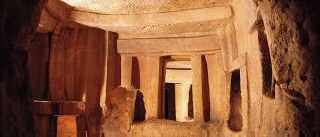
The Oracle Chamber is a small, carved room with a niche cut into its wall. When a voice or instrument sounds at approximately 110 Hz (around the A below middle C), the entire chamber resonates. The walls amplify and sustain the tone. The effect is visceral—the sound seems to come from everywhere and nowhere, filling the body as much as the ears.
The neurological connection: Dr. Ian Cook at UCLA found that 110 Hz stimulation specifically affected the prefrontal cortex, shifting activity patterns toward the right hemisphere—associated with emotional processing, creativity, and non-linear thinking. The exact frequency the Hypogeum amplifies.
The chamber also features ochre-painted spirals on its ceiling, patterns that some researchers link to altered states of consciousness. Whether the builders understood the neuroscience is unknowable. That they understood the effect seems certain.
Newgrange: Capturing the Voice
Ireland's Newgrange passage tomb, built around 3200 BCE (older than Stonehenge, older than the Egyptian pyramids), is famous for its winter solstice alignment—a roof box allows sunlight to penetrate the chamber only at dawn on the shortest days of the year.
Less famous but equally remarkable: the acoustic properties of the passage. Aaron Watson and David Keating's research demonstrated that the chamber amplifies frequencies around 110 Hz while dampening others. Standing waves form at specific pitches, creating zones of intense resonance. Drumming or chanting at the right frequency produces an enveloping, almost hallucinogenic sound field.
The corbelled ceiling, the precise passage length, the stone selection—all contribute to an acoustic environment unlike natural caves. The tomb was designed to do something to sound.
The Oracle at Delphi
For over a thousand years, pilgrims traveled to Delphi to consult the Pythia, the priestess who delivered prophecies while seated over a fissure in the earth. Ancient accounts describe her entering trance states, speaking in altered voices, delivering messages believed to come from Apollo himself.
Modern analysis has revealed several factors that may have contributed to these experiences. Geological studies found that the temple sits above intersecting fault lines that may have released ethylene gas—a mild intoxicant. But acoustic analysis adds another dimension: the adyton (inner sanctuary) where the Pythia sat was designed to amplify low frequencies while creating complex reverberations.
A voice speaking or chanting in the adyton would have sounded otherworldly to both speaker and listener. Combined with incense, ritual preparation, and possibly geological emissions, the acoustic design was part of a multisensory technology for inducing altered states.
Gothic Cathedrals: Engineering Transcendence
The medieval cathedral builders left more explicit records of their acoustic intentions. The long reverberation times of Gothic spaces—sometimes exceeding ten seconds—were not accidental. Gregorian chant was composed specifically for these acoustics, with sustained tones and open harmonies that exploit cathedral resonance.
Stone vaulting, parallel walls, and minimal soft furnishing create what acousticians call a "reverberant field"—sound energy persists and fills the space uniformly. A choir singing in Notre-Dame (before the 2019 fire) would hear their own voices return to them, transformed, seemingly multiplied. The architecture made the music supernatural.
Recent research by acoustic engineers has mapped the resonant frequencies of various cathedrals. Many cluster around frequencies associated with meditative states. Chartres Cathedral, for instance, has strong resonance in the theta brainwave range when scaled to standing wave patterns. Whether by intuition, experiment, or divine inspiration, the builders created spaces that altered consciousness.
Chavín de Huántar: The Peruvian Sound Temple
In the Peruvian Andes, the 3,000-year-old temple complex of Chavín de Huántar contains a network of underground galleries with extraordinary acoustic properties. Stanford archaeoacoustics researcher Miriam Kolar has documented how the passages selectively amplify specific frequencies, create disorienting echoes, and produce sound that seems to move through walls.
Pututu (conch shell) trumpets found at the site produce frequencies that the architecture amplifies. In some passages, sounds seem to emerge from the stone itself. In others, a voice becomes multiple voices. The effect, Kolar argues, was deliberate—a technology of disorientation designed to produce religious experiences.
Carved stone heads with wild expressions line some passages. Imagine walking these corridors by torchlight, hearing sounds that defy normal acoustics, uncertain what is natural and what is architecture. The builders understood something about sound and psychology.
Stonehenge: The Missing Resonance
Stonehenge presents a puzzle. Research by acoustic engineer Trevor Cox demonstrated that the original, complete stone circle would have had significant acoustic properties—reflecting and containing sound within the space. Today's ruin shows only traces of this, but computer models suggest the complete monument would have created a reverberant enclosure unlike the open plain surrounding it.
The bluestones transported from Wales (a journey of 150 miles) were specifically selected. Some researchers speculate they were chosen for acoustic properties—certain stones "ring" when struck. Whether Stonehenge was a sound instrument, a sound container, or something else remains debated. That acoustics mattered seems increasingly likely.
What the Ancients Knew
We cannot know whether Neolithic builders understood acoustics in any theoretical sense. They left no textbooks, no treatises on resonance. But the consistency of findings across cultures and millennia suggests something beyond coincidence:
- The same frequency ranges appear repeatedly (particularly around 110 Hz)
- Sacred spaces are acoustically distinct from ordinary architecture
- The specific frequencies amplified correlate with modern findings about altered states
- Ritual practices (chanting, drumming, singing) exploit these acoustic properties
Knowledge can be empirical without being theoretical. A builder might not know the term "resonant frequency" while understanding perfectly well that this shape makes voices strange, this stone rings when struck, this chamber puts people in trance. Traditions pass down what works.
Implications for Sound Healing
Modern sound healing practitioners work with the same fundamental principle: specific frequencies affect consciousness. We use singing bowls, gongs, and tuning forks; they used architecture, stone, and voice. The scale differs; the insight may not.
When you play a crystal bowl tuned to 110 Hz, you are working with a frequency that humans have known—in some form—for five thousand years. When you create a sound bath that shifts brainwave states, you are practicing a technology that ancient builders encoded in stone.
We are not inventing sound healing. We are remembering it.